

🔧 RTL Design · Formal Verification · AI Safety · Published Researcher
Final-year ECE student (RGMCET, JNTUA) with a peer-reviewed publication in analog mixed-signal design and deep experience in formal verification (k-induction, BMC, SVA assertions). Currently applying formal methods thinking to LLM safety research — bridging hardware verification rigour with AI alignment problems.
📧 sushmasai1704@gmail.com · 📍 Anantapur, India · LinkedIn · GitHub
"A Ripple-Free Low-Noise Bandgap Reference Circuit Using PNP Bipolars in 90nm CMOS" Peer-reviewed research · 2026 · Notable for an undergraduate project at this stage. Designed in Cadence Virtuoso (GPDK 90nm CMOS) · <2 mV drift across −40°C to +120°C.
| Domain | Tools & Technologies |
|---|---|
| RTL Design | SystemVerilog, Verilog, RISC-V RV32I, FSM design |
| Formal Verification | SymbiYosys, SVA, Z3 SMT Solver, k-induction, BMC, counterexample-driven debug |
| Physical Design | OpenLane, OpenROAD, Magic, KLayout, Sky130A 130nm PDK |
| Analog / Mixed-Signal | Cadence Virtuoso, GPDK 90nm CMOS, bandgap references, PNP bipolars |
| Protocols | AXI4, AXI4-Lite |
| Simulation | Icarus Verilog, Verilator 5.x, GTKWave, OSS CAD Suite |
| Instrumentation | LabVIEW, MATLAB (FFT/PSD), oscilloscopes, signal analysers |
| AI Safety & ML | Python, scikit-learn, Groq API, LLM jailbreak detection, formal property checking |
| Software | C, C++, Git, Linux/Ubuntu, LaTeX |
| Project | Description | Tools |
|---|---|---|
| llm-jailbreak-detector | Hybrid LLM jailbreak detector — formal property checking (BMC-style) + Groq LLM semantic layer. 100% accuracy, zero API cost for rule-covered cases. Formal methods applied to AI safety. | Python · Groq API |
| pwm-3phase-controller | 3-phase PWM RTL→GDSII on Sky130A — 0 DRC errors, LVS clean, 9 properties proved by k-induction | OpenLane · Magic · KLayout · SymbiYosys |
| riscv_pipeline_cpu | 5-stage pipelined RV32I CPU — full forwarding, hazard detection, BHT+BTB branch predictor, CPI 1.78 | Verilog · Icarus Verilog |
| fv-axi4lite-slave | Formally verified AXI4-Lite slave IP — 8 SVA temporal assertions, uncovered silent data-corruption bug invisible to 1000+ simulation cycles, proof closure via k-induction (depth 20) | SymbiYosys · Z3 · SystemVerilog |
| fv-arbiter | Formally verified 4-requester round-robin arbiter — 6 SVA properties: reset safety, one-hot grant, grant-implies-request | SymbiYosys · Z3 |
| systolic_array | Systolic array for matrix multiplication — ML hardware accelerator | SystemVerilog |
| PCB-Fault-Classifier | ML-based PCB fault detection — 94% accuracy, automates voltage-capture diagnosis in <5ms | Python · scikit-learn |
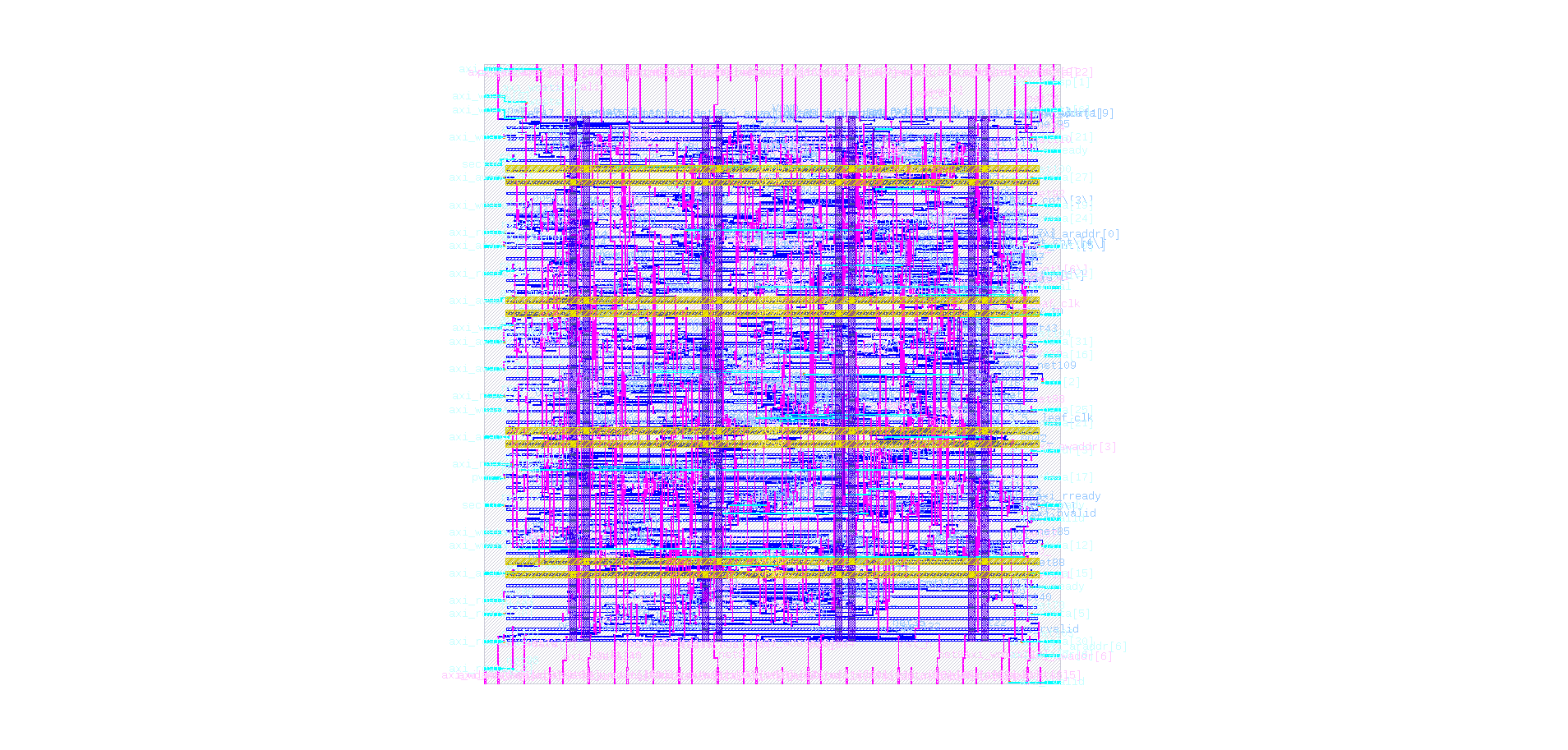
Full RTL→GDSII flow: synthesis → floorplan → placement → routing → DRC/LVS clean.
Most ECE students specialise in either hardware or software. My background spans:
- Formal verification (hardware) → AI safety (LLM jailbreak detection) — same rigorous property-based thinking, different domain
- Analog design (bandgap circuit, published) → ML (PCB fault classifier) — mixed-signal to data-driven
- RTL/CPU design (RISC-V) → AI accelerators (systolic array) — silicon to ML systems
I approach every problem the way a verification engineer would: define the properties, find the counterexamples, prove correctness.
VLSI Design Club, RGMCET — Conducted workshops on DFT, physical design flows, DRC/LVS, and tape-out preparation for 60+ junior students.
Open to research residencies, internships, and full-time roles in AI safety, VLSI design, and hardware-software co-design.