Tabular-infused Parameter Efficient Finetuning (tipeft) is a novel PEFT method designed to infuse tabular features into the initialization process of re-parameterization parameter efficient finetuning (PEFT) methods. This provides an element of well-informed and representational capacity towards the newly introduced PEFT parameters, which are usually introduced and initialized independently
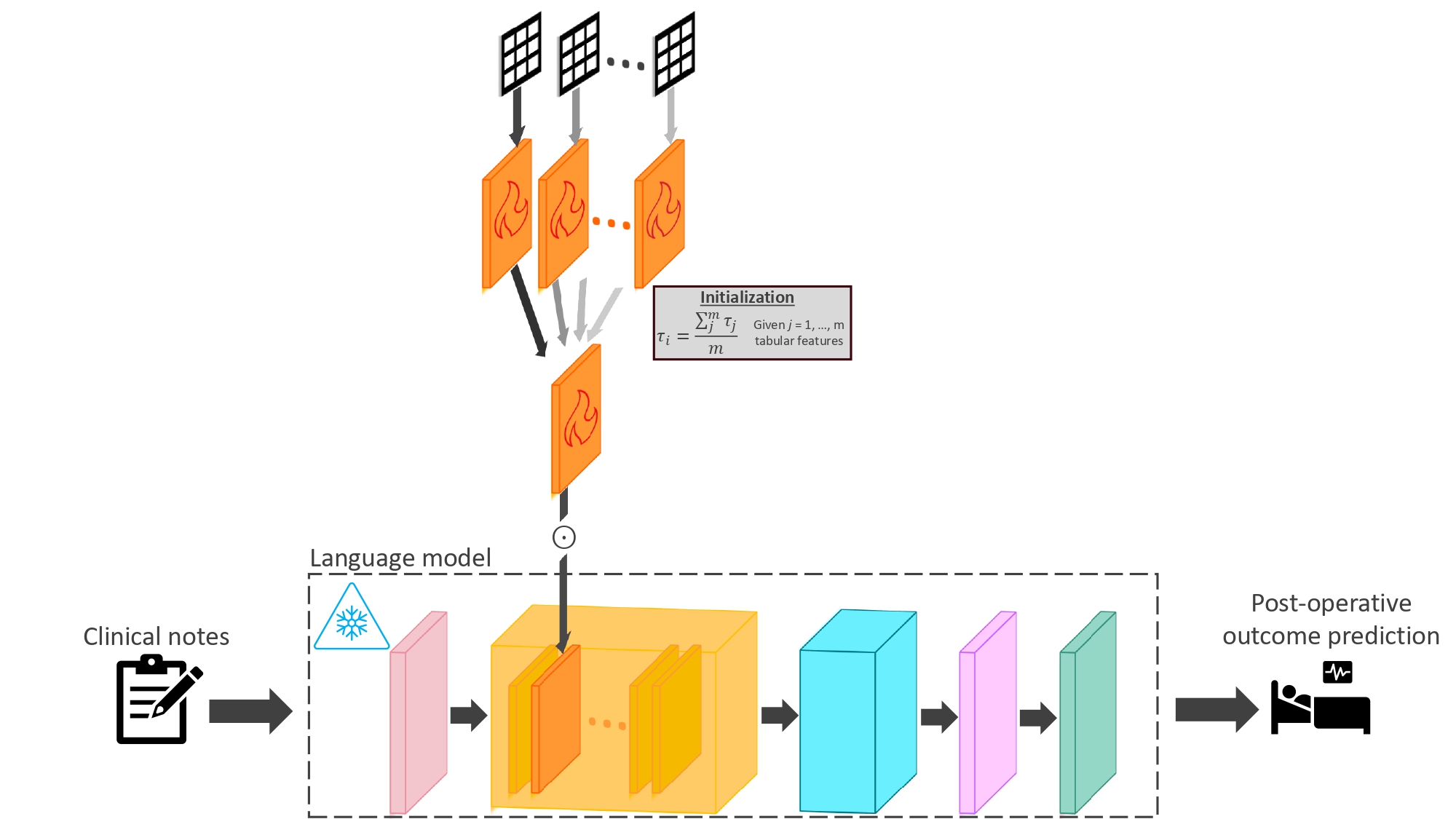
It is specifically designed for postoperative predictions in clinical care, where predictive and valuable pre-operative tabular features are often under-utilized in language model finetuning. For now, it supports both LoRA and IA3
The following Python packages are required for tipeft:
torchtransformerspeftacceleratenumpypandasscikit-learntqdm
Install dependencies with:
pip install torch transformers peft accelerate numpy pandas scikit-learn tqdmBecause PyTorch wheels vary by CUDA version and hardware, it is recommended to install PyTorch manually following the instructions at https://pytorch.org/
tipeft has been tested and verified on the following configuration:
- OS: Windows 10
- Python: 3.9.19
- CUDA: 12.6
- Environment: Must be run in a Jupyter notebook. Running as a standalone Python script may cause multiprocessing issues.
- CPU cores: At least 10 CPU cores recommended (uses
Pool(processes=10)internally). - GPU: CUDA-compatible GPU required.
- OS: Tested on Windows. Linux/Mac compatibility not yet verified.
- Jupyter only - Uses
tqdm.notebookwhich may not display correctly outside Jupyter. - Multiprocessing - May behave differently on Linux/Mac due to different multiprocessing backends.
If you encounter issues on a different setup, please open an issue with your system info.
tipeft is designed for GPU acceleration.
- At least 1 GPU is recommended
- Suggested minimum: 16GB VRAM
- Memory usage depends on:
- sequence length
- model size
- batch size
- peft configuration
To install in python, simply do the following:
pip install tipefttrain(pandas.DataFrame): Training dataframe containing text, label, and tabular feature columns (required)val(pandas.DataFrame): Validation dataframe with same structure as train (required)pretrained_model_name(str): Base model to fine-tune. Supports"emilyalsentzer/Bio_ClinicalBERT"or"microsoft/biogpt"(required)label_col(str): Column name of the binary outcome label. Must containTrue/Falsevalues. (required)text_col(str): Column name containing the clinical text (required)columns_unique_labels_of_tabular_features(dict): Map feature names to unique values. Use1for continuous,>1for categorical. (required)lr(float): Learning rate for final model training (default:0.001)num_epochs(int): Number of training epochs (default:5)lr_of_tabular_infused_features(float): Learning rate for tabular pre-training (default:0.0001)
model(PeftModel): The trained IA3 modeltokenizer(AutoTokenizer): The tokenizer for the model
from tipeft import train_tabular_infused_IA3

model, tokenizer = train_tabular_infused_IA3(
    train=train_df,
    val=val_df,
    pretrained_model_name="emilyalsentzer/Bio_ClinicalBERT",
    label_col="in_hospital_mortality",
    text_col="clinical_notes",
    columns_unique_labels_of_tabular_features={
        "gender": 2,
        "insurance": 3,
        "marital_status": 4,
        "anchor_age": 1,
        "anchor_year": 1
    },
    lr=0.001,
    num_epochs=5,
    lr_of_tabular_infused_features=0.0001
)- The
label_colmust contain boolean values (True/False) - Categorical features should have
>1unique labels incolumns_unique_labels_of_tabular_features - Continuous/numerical features should have
1as their value incolumns_unique_labels_of_tabular_features - Ensure all unique values in categorical columns appear in both train and val sets
- The trained model is saved to
trained_models/IA3_{pretrained_model_name}_{label_col}
train(pandas.DataFrame): Training dataframe containing text, label, and tabular feature columns (required)val(pandas.DataFrame): Validation dataframe with same structure as train (required)pretrained_model_name(str): Base model to fine-tune. Supports"emilyalsentzer/Bio_ClinicalBERT"or"microsoft/biogpt"(required)label_col(str): Column name of the binary outcome label. Must containTrue/Falsevalues. (required)text_col(str): Column name containing the clinical text (required)columns_unique_labels_of_tabular_features(dict): Map feature names to unique values. Use1for continuous,>1for categorical. (required)lr(float): Learning rate for final model training (default:0.001)num_epochs(int): Number of training epochs (default:5)lr_of_tabular_infused_features(float): Learning rate for tabular pre-training (default:0.0001)
model(PeftModel): The trained IA3 modeltokenizer(AutoTokenizer): The tokenizer for the model
from tipeft import train_tabular_infused_lora

model, tokenizer = train_tabular_infused_lora(
    train=train_df,
    val=val_df,
    pretrained_model_name="emilyalsentzer/Bio_ClinicalBERT",
    label_col="in_hospital_mortality",
    text_col="clinical_notes",
    columns_unique_labels_of_tabular_features={
        "gender": 2,
        "insurance": 3,
        "marital_status": 4,
        "anchor_age": 1,
        "anchor_year": 1
    },
    lr=0.001,
    num_epochs=5,
    lr_of_tabular_infused_features=0.0001
)- The
label_colmust contain boolean values (True/False) - Categorical features should have
>1unique labels incolumns_unique_labels_of_tabular_features - Continuous/numerical features should have
1as their value incolumns_unique_labels_of_tabular_features - Ensure all unique values in categorical columns appear in both train and val sets
- The trained model is saved to
trained_models/lora_{pretrained_model_name}_{label_col}
Contact me at alba@wustl.edu