| title | fak benchmarking visuals and overall status (2026-06-18) |
|---|---|
| description | One front door for fak's benchmark evidence: syscall latency, fleet turn-tax sweeps, fan-out, realistic workloads, and the executive value projection charts. |
One front door for the current benchmark evidence. The plots below are tracked PNGs regenerated from the checked-in CSV/JSON artifacts on 2026-06-18; the executive value-sweep charts are also exported as SVG/PDF/JPG for decks and print. The measurement claims stay in the per-benchmark result docs linked from each row.
| Area | Evidence | Status |
|---|---|---|
| Syscall subsystem check | fak/STATUS.md, fak/report.json, fak/baseline.json |
Green, but narrow. In-process adjudication p50 is single-digit microseconds vs a process-per-decide spawned-hook baseline in the milliseconds, gate_primary=pass — currently ~2,427 ns vs ~6.913 ms (~2,849× p50, n=100) per the live STATUS.md/CLAIMS.md; the ms figure floats with machine load (an earlier run recorded 13.203 ms ⇒ ~5,583×, this box's report.json ~12.7 ms), always ≫1 — read the per-doc numbers, not this snapshot. The baseline is the Go fak hook full-binary spawn — the same Fold decide measured over two transports — NOT a Python interpreter spawn. A per-decide Python hook is a different and much slower baseline class (the interpreter-free hot path is the boundary fak exists to remove); do not read this ratio as a win over Python. This proves the syscall/adjudicator path is not paying a per-call process boundary; it is not a production-readiness or serving-throughput headline. |
| Fleet sweep | fak/FLEET-SWEEP-RESULTS.md, fak/experiments/fleet/*.csv |
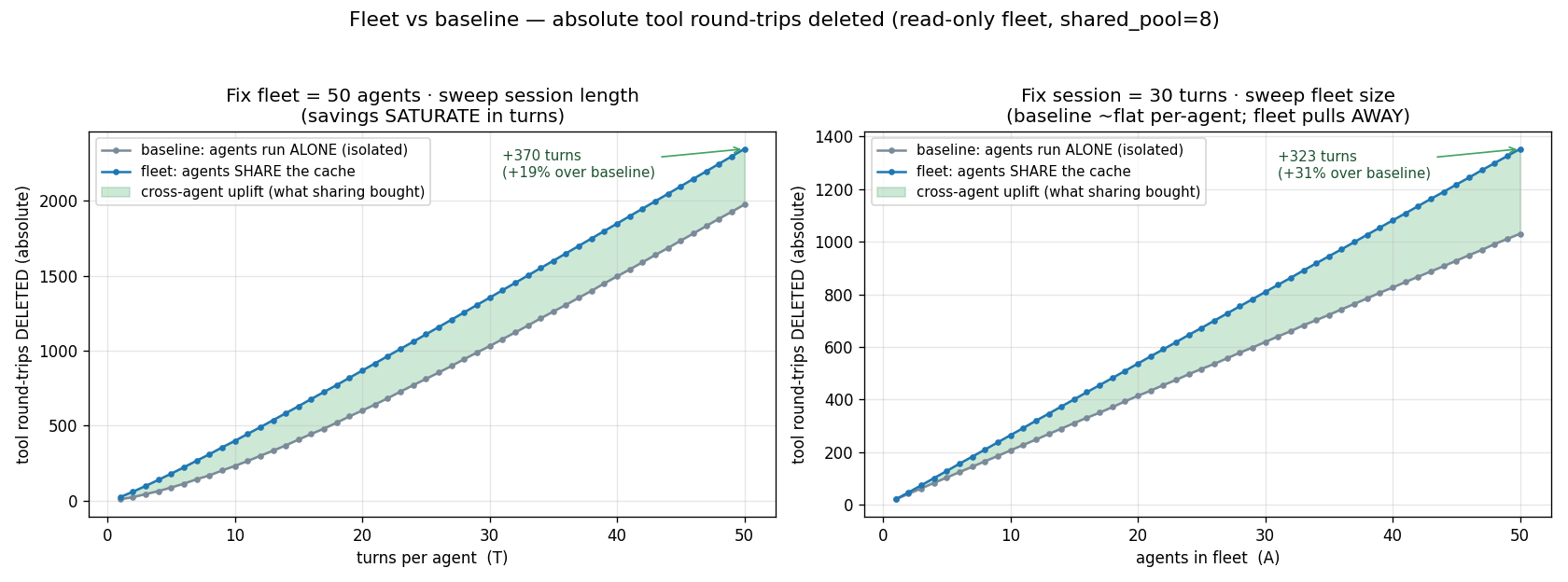
Measured on the real kernel. The 50x50 read-fleet corner deletes 2,344/2,500 calls; the cross-agent bonus is +370 turns vs isolated agents. No-share controls are exactly zero. |
| Write invalidation fix | FLEET-ERASER-RESULTS.md (private companion — not published), fak/experiments/fleet/eraser/eraser-summary.csv |
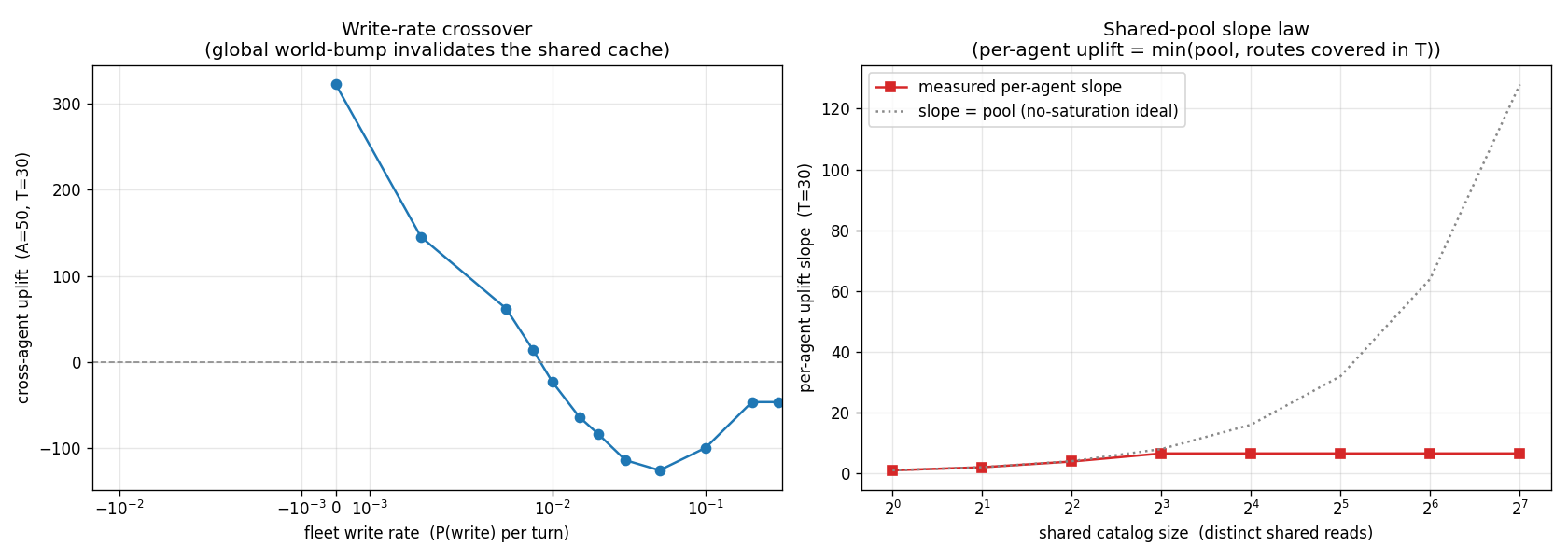
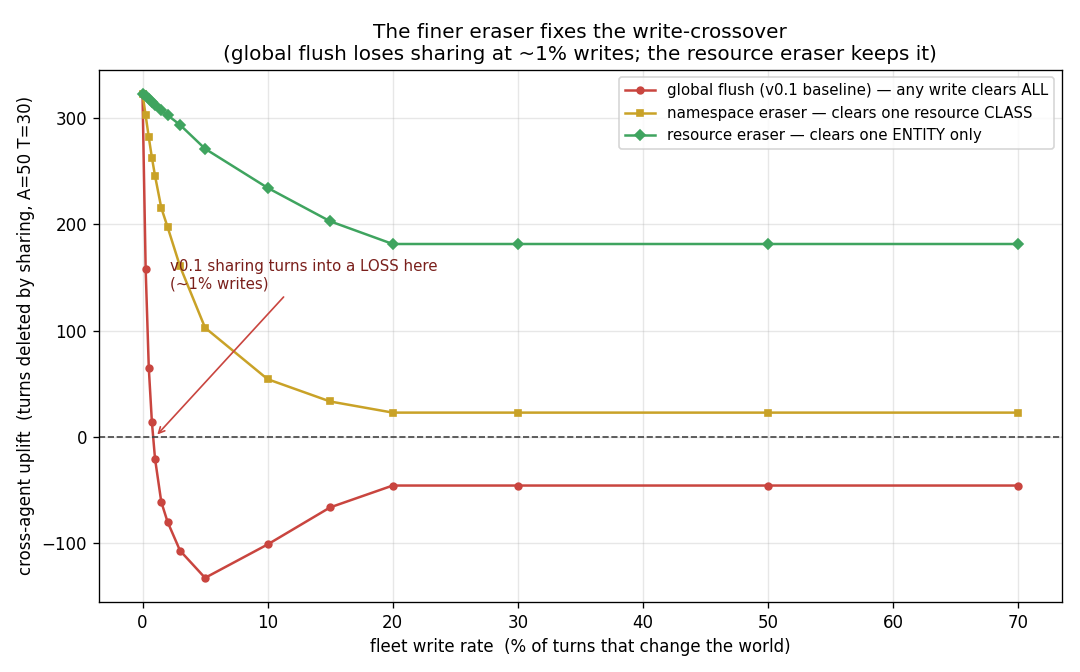
Built and measured. Global invalidation turns negative around 1% writes; resource-scoped invalidation keeps +313 uplift at 1% writes and +235 at 10% writes. |
| Single-goal fan-out | fak/FANOUT-BENCH-RESULTS.md, fak/experiments/fanout/fanbench-research.csv, fak/experiments/fanout/pscale/p1048576.json |
Measured plus modeled. At N=1024, the real shared-world path deletes +1,005 sibling-only tool-result calls; at fixed N=256, the prefix-scale ladder now reaches P=1,048,576 and the model claws back 89.8% of the prefix tax. Caveat: this is token-economics geometry, not yet a real 1M-token model wall-clock. |
| Realistic workload | REALISTIC-WORKLOAD-RESULTS.md (private companion — not published), fak/experiments/agent-live/realistic-workload/profile.json (private companion — not published) |
Transcript-derived. The current regenerated profile is 96 sessions / 1,126 logical turns, median prefix 4,671 tokens, median decode 130 tokens, and 92.7% tool-call turns. |
| Executive value projection | FLEET-VALUE-PROJECTION.md (private companion — not published), the fak/experiments/value-sweep/ directory (private companion — not published) |
Measured plus theory, explicitly split. Sweeps 1 agent / 25 turns / 20k context to 100 agents / 250 turns / 500k context. Top-end read-heavy projection deletes 22,806/25,000 tool round-trips, with $123/run measured-turn value plus a theoretical $2.2k/run API-equivalent long-context residual. |
| Permission/API-host proof | VISUALS-permission-systems-2026-06-18.md, fak/experiments/permission-systems/, fak/experiments/api-host-bridge/ |
Scope-bounded proof. FAK/DOS covers the six hard-risk scenarios in the benchmark and the API-host bridge proof closes 16/16 declared requirements, while explicitly leaving internet-wide host behavior out of scope. |
The 2-D surface separates total fleet savings from the part that only appears when agents share one world epoch.
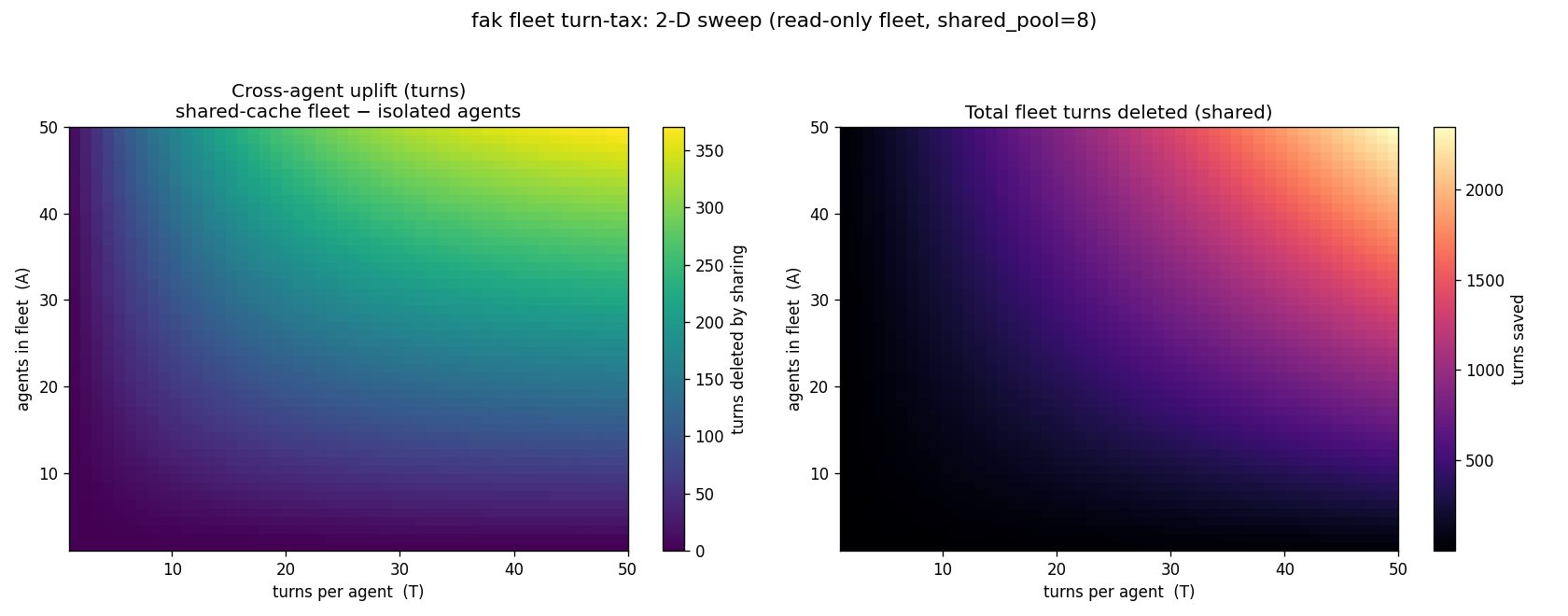
The plain-language companion shows the shared-cache fleet against the same agents run in isolated worlds; the shaded gap is the measured cross-agent uplift.
The write axis is the caution. Global invalidation is sound but too coarse; the resource eraser keeps the read-sharing benefit under realistic write rates.
fanbench is the missing topology between one agent and a fleet of independent
agents: one master goal decomposed into N sub-agents.
(figure not published)
The model-scaling view keeps N fixed and varies the shared master-goal prefix. It shows why larger shared context makes prefix reuse more valuable, while still labeling this as a reuse-vs-reprefill ablation rather than a win over tuned shared-prefix serving engines.
The checked-in pscale artifacts now extend the ladder from 1K through 1M prefix
tokens. The top row (p1048576.json) reports prefix_tokens_saved=267,386,880,
tax_clawed_back_frac=0.898, and $721/run modeled value at N=256. The PNG below
was regenerated against those artifacts on 2026-06-19 (matplotlib 3.10.9) and now
shows the full ladder through 1024K — the #107 plotting lag is resolved.
(figure not published)
The value projection is the executive roll-up. The chart is deliberately simple:
one takeaway, plain labels, and the assumptions printed on the image. The detailed
audit table stays in fak/FLEET-VALUE-PROJECTION.md.
(figure not published)
Exports (private companion — not published): value-sweep-headline.png /
value-sweep-headline.svg / value-sweep-headline.pdf /
value-sweep-headline.jpg; data value-sweep.csv / value-sweep.json.
The hardware sheet is an assumptions explainer for the self-host cold-prefill math: workload inputs, hardware inputs, and the three quoted outputs. Hardware affects the self-host dollars, GPU-hours, and kWh rows, not the measured turn counts.
(figure not published)
Exports (private companion — not published): value-sweep-hardware.png /
value-sweep-hardware.svg / value-sweep-hardware.pdf /
value-sweep-hardware.jpg.
The benchmark picture is now sharper than the original thesis:
- The structural security floor remains the durable claim: deny-by-policy and result containment do not depend on model judgment.
- The efficiency wins are real in their regimes, but bounded: read-heavy fleets benefit from shared tool-result cache; write-heavy fleets need scoped invalidation; fan-out claws back prefix tax but hits a fold-bound latency knee.
- The serving comparison is intentionally conservative. The fanout numbers
(
FANOUT-BENCH-RESULTS.md, value-sweep visuals) are FAK-vs-FAK ablations over reuse, not head-to-head claims against tuned SGLang/vLLM/llama.cpp prefix-sharing servers. The one exception is the session value-stack headline: it carries a committed tuned arm (per-agent warm-cache KV) and the measured head-to-head there is 4.1× vs tuned (60.3× vs naive), commit2bbda6f— seefak/BENCHMARK-AUTHORITY.md. Don't read "FAK-vs-FAK" as "no vs-tuned number anywhere"; it scopes the fanout bench, not the value-stack. - The long-prefix fanbench result aligns with the live/real-model evidence as a
reuse ceiling, not a safety proof or quality proof:
LIVE-RESULTS.mdproves the real-model containment floor, while fanbench prices repeated-work deletion after a valid trajectory exists. Real 256K-1M model wall-clock and quality curves are tracked separately (#104, #106). - The unbuilt residues are unchanged: external-engine zero-copy KV co-residence, GPU/token-per-watt telemetry, and a fine-tuned syscall/adjudication model remain outside the shipped critical path.
python tools\fanout_plot.py
python tools\fleet_heatmap.py
python tools\fleet_compare.py
python tools\fleet_eraser.py
python tools\fleet_value_projection.py
These scripts read the checked-in artifacts under fak/experiments/fanout/ and
fak/experiments/fleet/ plus the value-sweep projection inputs and write only the
dashboard PNG/CSV/JSON artifacts shown above. fleet_value_projection.py also writes
the value-sweep charts as SVG, PDF, and JPG.